The best roadside stops for kids are not the ones with the biggest sign. They are the ones where everyone gets ten minutes of real movement, a clean bathroom, and back on the road before the mood turns. That is the whole test. A stop that fails one of those three jobs costs you twenty minutes and buys you nothing.
Most families plan the route and forget the stops. Then the drive becomes a negotiation: one child needs the bathroom, another is carsick from screens, and the nearest exit is a gas station with one working faucet. The fix is a framework you can hold in your head. This article gives you one, plus a quick checklist you can run from the driver's seat.
It also covers what to do when the plan breaks, because it will. A flat tire with kids in the car is a different problem than a flat tire alone, and it pays to know who you are calling before you need them. If you have roadside assistance on your auto policy, State Farm explains how to check for it on your insurance ID card and what the coverage typically includes. More on that in the last section.
What Makes a Stop Worth Taking?
A good stop does three jobs at once. It lets kids burn energy. It gives adults a reset. And it does not eat more time than it saves. A stop that lets the kids run for ten minutes often buys you two quiet hours of driving. A stop with no space to move just resets the clock on the whining.
So judge every exit against four things: space to move, bathroom quality, food, and how fast you can get back on the highway. The first two matter most. Food you can handle from a cooler if the stop fails it. But a stop with no grass, no sidewalk loops, and no reason to walk is a stop worth skipping if the next one is twenty minutes further.
How Do You Judge a Playground From the Highway?
You cannot see much from an exit ramp, but you can see enough. Look for these signals before you commit:
- Fencing. A playground near a road that is not fenced means you shadow a toddler the whole time. A fenced one means you can sit for a second.
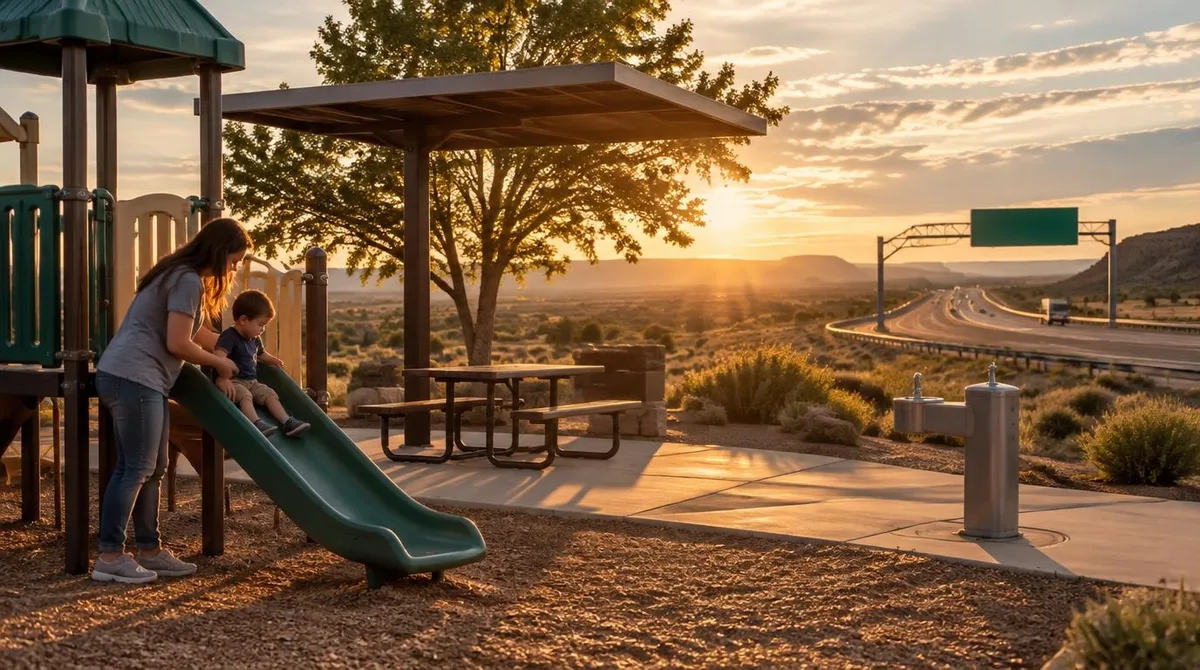
- Shade. Metal slides and black rubber surfacing in July are unusable by noon. Trees or a covered structure change the math.
- Age split. The best playgrounds separate the toddler equipment from the big-kid structure. One shared structure with a ten-foot slide means someone sits out.
- Sightlines. One open sightline from a bench to every piece of equipment beats a fancy maze layout you cannot supervise.
Rest area playgrounds are usually fenced and simple, which is exactly right for a twenty-minute stop. Town park playgrounds two or three minutes off the exit are often better equipment but cost more time. Decide which trade fits your day. On a long haul, take the boring fenced one. On a scenic route, the town park can be the lunch stop too.
What Should You Check Before Walking Into the Restroom?
Bathroom reliability is the least glamorous part of a road trip and the one that decides satisfaction. Send one adult in first as a scout when you can. It takes ninety seconds and saves a full-family walk-in at a restroom with no soap, no paper, and no working door lock.
Check for three things: soap in the dispenser, a changing surface, and whether the stall doors actually latch. If a restroom fails two of the three, use it if you must, but note the exit. On an interstate corridor, the good and bad restrooms cluster, and knowing which is which is worth more than any app. Family or companion restrooms, where offered, solve the latch and the changing table in one room and are worth waiting an exit or two for.
How Should You Handle Meal Breaks?
Split food into two jobs. Snacks happen in the car, and meals happen at a stop. Mixing them is how a family ends up eating fries over the back seat at 4 p.m. with dinner still ahead. If you pack ahead, you control both jobs; our guide to the best road trip snacks that survive a full car day covers what holds up without a cooler drain.
When you stop for a real meal, apply the same exit logic as a playground. Fast casual beats fast food here, not for the food but for the layout: more table room, usually a bathroom you do not need a code to enter, and no play structure trap that turns a fifteen-minute lunch into forty-five minutes of negotiation. If the town has a park within a couple of minutes of a Main Street restaurant, eat takeout at the park. Kids eat faster outdoors, and the stop does double duty. We covered a connected angle in The 4th Grade National Park Pass: Every Kid Outdoors, Step by Step.
What Are the Red Flags at Any Exit?
Some stops cost more than they give. Watch for these:
- Truck-only lots. No marked car parking means you are idling behind diesels and walking a toddler across truck lanes.
- Exits where the ramp road keeps going. If the services sit half a mile off the highway with no sidewalk, the walk itself becomes the hazard.
- Anything with a single road crossing between the lot and the food or playground. With kids, one crossing is one handhold per child per direction, four times.
- Gas station restrooms with a key on a hubcap. Fine for adults. With a potty-training kid, it is a delay you did not plan.
Our analysis after a lot of family miles: the exit you can see fully from the parking spot is almost always the right one. If you have to wonder what is around the building, pick the next exit.
What Is the Quick Scoring Checklist for Mid-Drive?
Run this from the driver's seat as you approach an exit. Two minutes, no app.
- Space: Is there grass, a loop of sidewalk, or a playground visible? Yes or no.
- Bathroom: Rest area, sit-down restaurant, or gas station? In that order of trust.
- Food: Do we need a meal, or do the snacks cover it? Check the cooler before you commit.
- Re-entry: Is the on-ramp easy from the parking lot, or does it loop through town?
- Time budget: Can this stop be done in fifteen minutes? If not, is it the planned long stop?
Three yes answers make a good quick stop. Fewer than that, and the next exit is usually worth the wait. One warning from experience that generalizes: never let the fuel gauge make the stop decision. Fuel stops chosen out of urgency are the worst stops on any route. Pick the stop first, then confirm it has gas.
What Do You Do When the Plan Breaks?
Two things break on family drives: the schedule and sometimes the car. The schedule you fix by cutting the next stop, not the current one. Skipping a planned stop to make up time is how a good day turns sour by dinner.
The car is the one worth preparing for. Roadside coverage through an auto insurer typically handles towing to the nearest repair facility and delivering gas, a battery or tires so the vehicle can be driven again; State Farm notes that delivery is covered but the items themselves are not, and that most of the time the provider bills the insurer directly. Check your ID card or your policy account before a long trip so you know whether you carry it, and keep your phone charged, since the insurer or its service partner may need to reach you by call or text. In a dangerous spot or if anyone is hurt, the guidance is simple: call 911 first, and if the vehicle is leaking fluids, move to a safe distance.
The one contingency worth knowing: if a breakdown happens with kids in the car, stay buckled in a safe spot and make the call from inside. A shoulder with traffic passing at highway speed is not a place to stretch legs, no matter how restless the back seat is. Everything else on this list is a preference. That one is a rule.